

About us
The Image X Institute is a centre for innovation in radiation therapy and cancer imaging technologies.
Our mission is to improve lives by inventing and advancing new ways to image and treat disease. We’re working on new technologies for medical imaging and targeted radiation therapy.
We engage with industry, hospitals, international collaborators and universities to forge relationships that help take our projects from lab bench to patient bedside.
Image X is a part of the Faculty of Medicine and Health at the University of Sydney. Explore more research within our faculty.
– View current Opportunities to work or study with us.
– Explore our research
– Meet our staff
– Subscribe for news
Latest News
March 2025
NHMRC Grant Success for Tess Reynolds and Paul Keall
Both Paul Keall and Tess Reynolds have been awarded highly competitive NHMRC Investigator Grants. These are 5-year grants that support the investigators and provide a research support package. Paul Keall, awarded $3M – Advancing image guided radiation therapy from discovery to clinical practice. The project will dramatically improve cancer treatment outcomes by advancing a pipeline of image guided radiation therapy innovations from discovery to clinical practice. Advanced radiation therapy innovations from this grant will potentially impact over 10 million cancer patients every year.
Tess Reynolds, awarded $1.6M – Unlocking the future of robotic imaging for surgical procedural navigation and verification. This project will develop imaging technologies that promise to allow direct in-room surgical verification of orthopaedic hardware, adaptively sync to the patient to mitigate motion without mechanical intervention and facilitate long anatomical sites to be captured in a single image to assess anatomy alignment intra-operatively.

Oct 2024
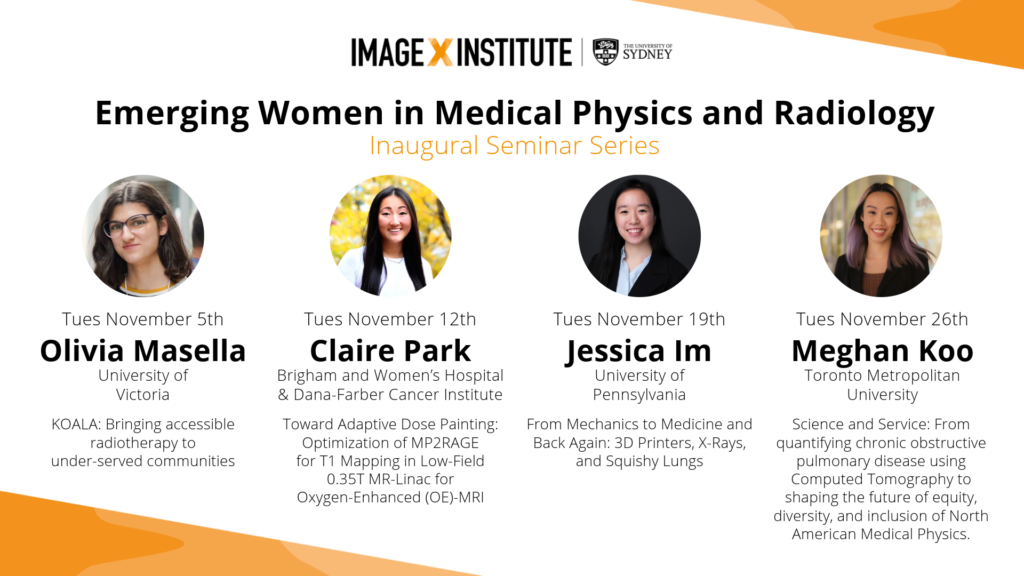
Inaugural Emerging Women in Medical Physics and Radiology Seminar Series
This November we’ll be holding our first inaugural Emerging Women in Medical Physics and Radiology Seminar Series. Join us on Tuesdays at 11am on zoom to learn about the amazing work being done across a range of fascinating areas, plus a post-talk Q&A with each speaker. This series has been initiated and curated by Tess Reynolds
More information and free registration here: MORE INFO + REGISTER
July 2024
Image X Researchers Awarded $2.9M in Medical Research Future Fund
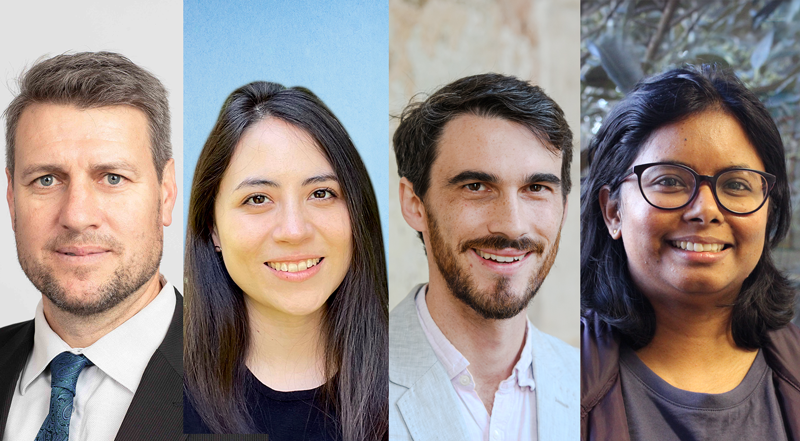
Paul Keall, Emily Hewson, David Waddington and Chandrima Sengupta are among the recipients of the $650 million Medical Research Future Fund (MRFF) National Critical Research Infrastructure initiative. The grant, titled “An AI Platform for Targeted Radiotherapy to Improve Cancer Patient Outcomes”, was publicly announced this week by Minister for Health and Aged Care, The Hon Mark Butler MP.
“These important research projects will help build the infrastructure that will underpin our use of AI in the healthcare system, improving the lives of Australians everywhere.” Said Minister Butler.
Subscribe to our e-newsletter
Click here for the sign up page
(opens in new tab)
View previous issues here.
Contact us
Phone: +61 2 8627 1106
Email: image-x.contact@sydney.edu.au
Social media: Facebook | Twitter
Level 2, Biomedical Building (C81)
1 Central Ave
Australian Technology Park
Eveleigh NSW 2015
University Internal Mailing
Suite 201, C81-Biomedical Building,
University of Sydney, NSW 2006