
Big data maps world's ocean floor
Scientists from the University of Sydney's School of Geosciences have led the creation of the world's first digital map of the seafloor's geology.
It is the first time the composition of the seafloor, covering 70 percent of the Earth’s surface, has been mapped in 40 years; the most recent map was hand drawn in the 1970s.
Published in the latest edition of Geology, the map will help scientists better understand how our oceans have responded, and will respond, to environmental change. It also reveals the deep ocean basins to be much more complex than previously thought.
“In order to understand environmental change in the oceans we need to better understand what is preserved in the geological record in the seabed,” says lead researcher Dr Adriana Dutkiewicz from the University of Sydney.
“The deep ocean floor is a graveyard with much of it made up of the remains of microscopic sea creatures called phytoplankton, which thrive in sunlit surface waters. The composition of these remains can help decipher how oceans have responded in the past to climate change.”
A special group of phytoplankton called diatoms produce about a quarter of the oxygen we breathe and make a bigger contribution to fighting global warming than most plants on land. Their dead remains sink to the bottom of the ocean, locking away their carbon.
The new seafloor geology map demonstrates that diatom accumulations on the seafloor are nearly entirely independent of diatom blooms in surface waters in the Southern Ocean.
“This disconnect demonstrates that we understand the carbon source, but not the sink,” says co-author Professor Dietmar Muller from the University of Sydney. More research is needed to better understand this relationship.
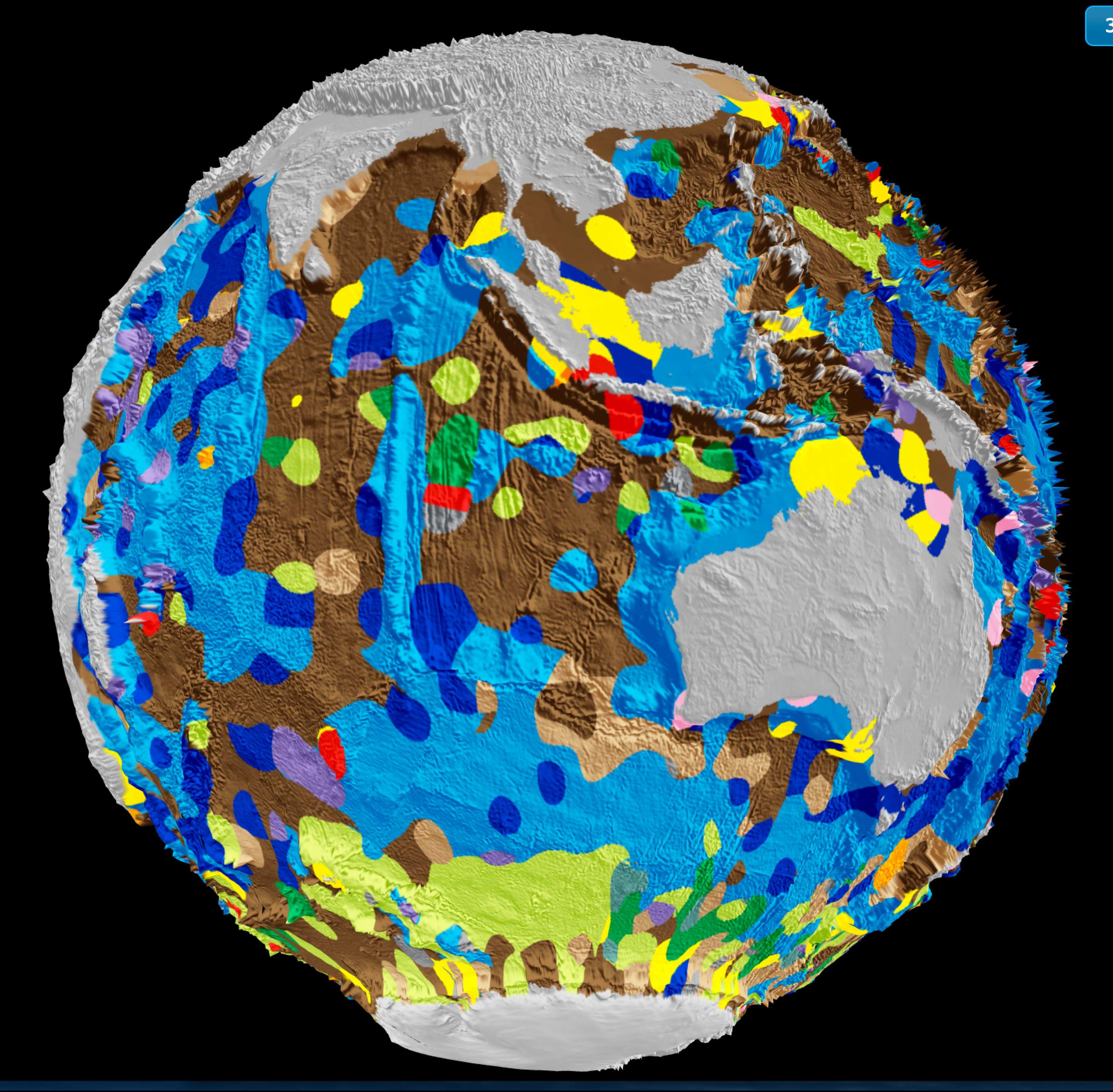
A still shot of the world's first digital map of the seafloor's geology.
Dr Dutkiewicz said, “Our research opens the door to future marine research voyages aimed at better understanding the workings and history of the marine carbon cycle. Australia’s new research vessel Investigator is ideally placed to further investigate the impact of environmental change on diatom productivity. We urgently need to understand how the ocean responds to climate change.”
Some of the most significant changes to the seafloor map are in the oceans surrounding Australia.
“The old map suggests much of the Southern Ocean around Australia is mainly covered by clay blown off the continent, whereas our map shows this area is actually a complex patchwork of microfossil remains,” said Dr Dutkiewicz. “Life in the Southern Ocean is much richer than previously thought.”
Dr Dutkiewicz and colleagues analysed and categorised around 15,000 seafloor samples – taken over half a century on research cruise ships to generate the data for the map. She teamed with the National ICT Australia (NICTA) big data experts to find the best way to use algorithms to turn this multitude of point observations into a continuous digital map.
“Recent images of Pluto’s icy plains are spectacular, but the process of unveiling the hidden geological secrets of the abyssal plains of our own planet was equally full of surprises!” co-author Dr Simon O’Callaghan from NICTA said.
This research is supported by the Science and Industry Endowment Fund.
The digital data and interactive map are freely available as open access resources.
Related articles
Resetting the table to halt expanding waistlines
Can farmers, producers and regulators work together at all points of the food supply chain to help curb Australia's growing obesity problem?

Sydney's cyclists twice as happy as other commuters: new research
Sydney's commuting cyclists are twice as happy as people who drive, walk or use public transport to get to work, University of Sydney research reveals.
'Passion' key to being a successful leader
Leadership is about following a passion, having a belief in what you're doing and understanding that people matter, explained NSW Premier Mike Baird at the latest BOSS Emerging Leaders event.
Sydney alumni echo our vision of leadership
We celebrate the achievements and values of our students and alumni in a campaign that rolled out on campus, online, and on train stations, buses and street posters across Sydney last week.
Eureka Prize for Associate Professor Michael J. Biercuk
Associate Professor Biercuk was recognised with the prestigious prize for contributions at the leading edge of quantum science research.
Legal risk in bombing Syria
The government faces some thorny legal questions as the fight against Islamic State draws our troops towards Syria, writes Malcolm Jorgensen.
Athletes score for disability and donors
Wheelchair basketball athletes from the NSW Institute of Sport and Wheelchair Sports NSW showed their support for the Pave the Way campaign this week.
Scientists should take a leaf out of wellness bloggers' books
How can we distinguish credible wellness information from unfounded pseudoscience? And why is it that wellness gurus are often taken more seriously than scientists? Jackie Randles writes.
Seventeen at Belvoir – a brilliant theatrical event with a happy, hetero ending
"As a gay man watching the play's ending, I felt I'd seen this story too many times to feel part of its investments in the future," writes Dr Huw Griffiths.
Ping pong diplomacy
Vice-Chancellor Dr Michael Spence and Chinese Consul General Li Huaxin faced off in a friendly ping-pong match this week.